From GeoCities to Facebook: the centralization of the web
Previously…
We have seen that the web has been accompanied by counter-cultural currents that share a common set of goals:
Building an equitable dematerialized society;
Maintaining a critical stance toward the infrastructure we use to communicate.
Let us now look at how this open space has, over thirty years, re-centralized around a handful of private infrastructures.
Chapter 1
Web 1.0
A hand-crafted, vernacular web, linking together a few personal sites put online by enthusiasts — those with sufficient technical skills — connected through human editorial choices.
”Web 1.0”, a name given after the fact
The term emerges naturally in opposition to “Web 2.0”, coined in the early 2000s. It is therefore a label forged by those who had an interest in legitimizing a rupture.
GeoCities: inhabiting an address
GeoCities is an emblematic example of this “Web 1.0”.
In 1994, the company Beverly Hills Internet (renamed GeoCities in 1995) offered free hosting for personal pages.
The organization is spatial: each user chooses a thematic “neighborhood” (SiliconValley for technology, WestHollywood for LGBT culture, Athens for philosophy…) and receives an address such as geocities.com/SiliconValley/2043.
Yahoo! bought GeoCities in 1999 for $3.57 billion, then shut down the service in 2009. Part of the content was rescued by Archive Team and is today accessible on the Internet Archive — a precious archive of the vernacular web.
A spatial metaphor
The neighborhood metaphor is no accident: one inhabits an address, one has neighbors, one visits a site. The web is still thought of as a territory.
Marshall McLuhan had already anticipated this dimension in Understanding Media (1964), notably through the metaphor of the global village.
Webrings and the neighborhood web
To connect these spaces, new forms emerge. In 1995, Sage Weil invents webrings to link sites sharing a common interest: each site displays a small navigation block that functions like a mini personal address book, edited by the webmaster of the site.
A Calvin & Hobbes webring
A vernacular aesthetic
These initiatives show that this space is still being tinkered with. Built by amateurs, the first sites explore visual possibilities and produce a highly recognizable aesthetic.
Artist and theorist Olia Lialina has thematized this dimension in A Vernacular Web (2005). She proposes looking at these pages as an autonomous visual language, with its own visual culture.
Olia Lialina also maintains One Terabyte of Kilobyte Age, a project preserving GeoCities pages saved before the 2009 shutdown.
By the end of the 1990s, several limits had become apparent:
Publishing remains technical: one has to write HTML, manage FTP, understand what a server is.
Discovery is laborious: directories (Yahoo!, DMOZ) can no longer keep pace with the web’s growth.
The economy is searching for a model: the dot-com bubble bursts in 2000, leaving the industry in search of an economically viable model.
“Web 2.0” will respond to these points, but the response will come at a cost for users.
Chapter 2
Web 2.0
This is the moment when the web becomes a technology truly accessible to everyone. But this ease of use — enabled by the new platforms — will come at the expense of our ability to really master those platforms.
The dot-com bubble bursts
It begins with an economic bubble that bursts in 2000; tech companies all operate at a loss and must quickly find a new economic model if they are to remain viable.
Web 2.0 to the rescue
Tim O’Reilly coins the concept in 2004. In 2005, he publishes What Is Web 2.0, a landmark article summarizing in a few points the ambitions for the web to come:
The web as platform: decentralize the service;
Harness collective intelligence: user activity becomes the engine of content;
Data is the new “Intel Inside”: the database becomes a capital asset to protect;
Software as a service: continuously updated, no longer a finished product;
The network effect: the more users, the more valuable the service becomes.
O’Reilly is here both judge and party; he sells technical books and organizes the conferences where investors and founders meet. Defining Web 2.0 is already a way of shaping its market.
Tools that democratize but standardize
This is the rise of platforms and services that offer tools allowing users to share content without much technical knowledge.
Screenshot of a Myspace page
WordPress and the opening of blogging to the general public
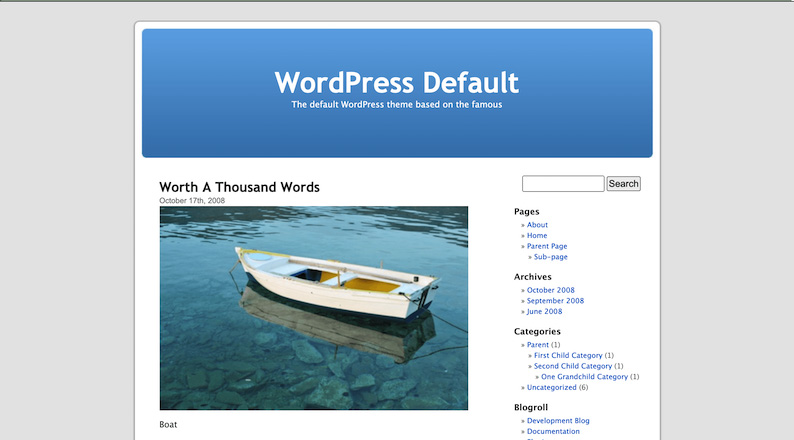
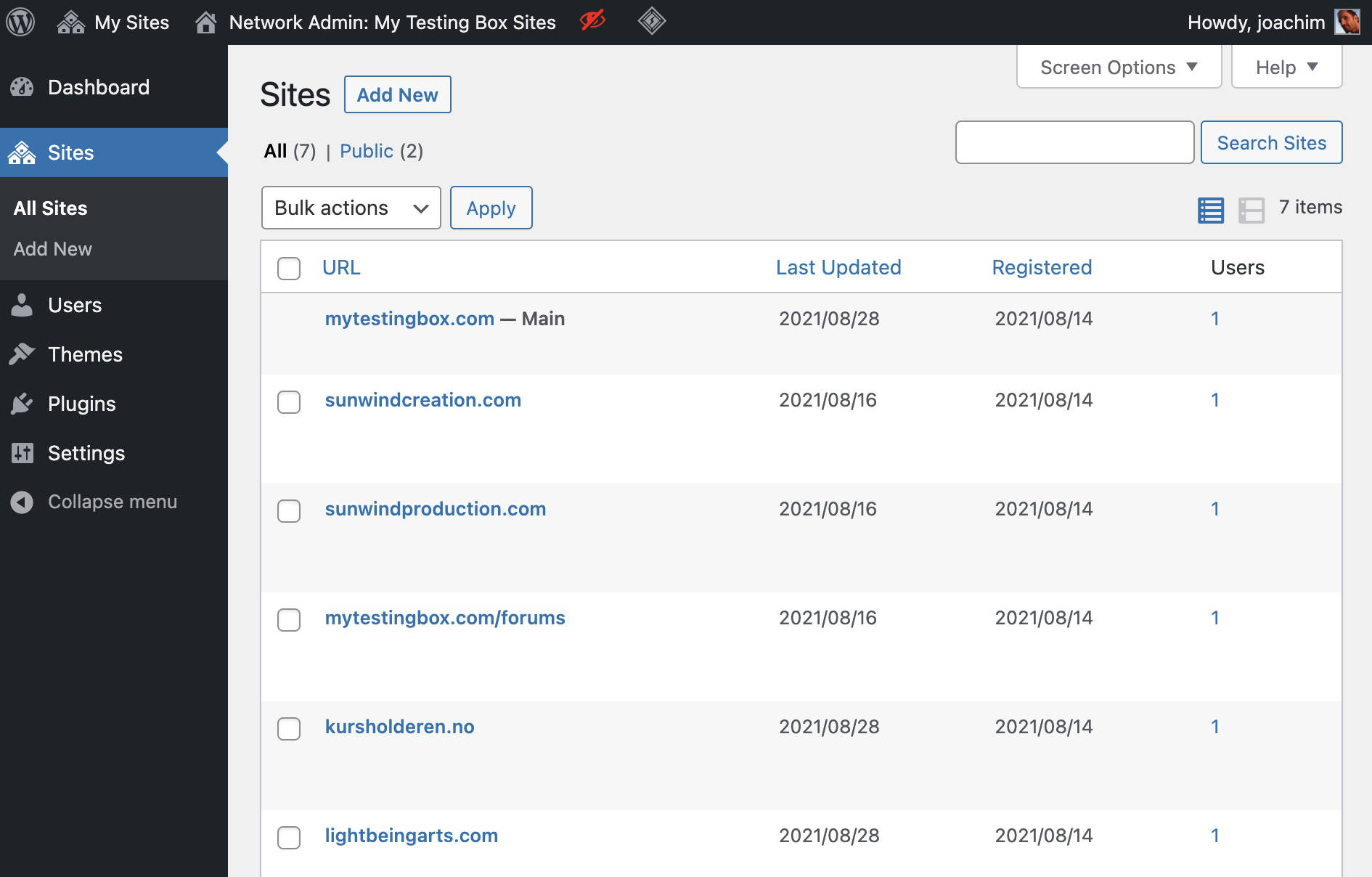
In 2003, Matt Mullenweg and Mike Little create WordPress, a content management system (CMS). Content and form are separated: the user manages content via the admin page, and the site — whose form is chosen from a library of possibilities — is updated automatically.
One of the first WordPress themes (Kubrick)
Separating content and form
Despite restricted possibilities, it was possible — with WordPress, MySpace, Blogspot, Skyblogs and other platforms — to customize one’s interface (colors, typefaces, background images). Users could tinker with the CSS to give their page some individuality.
The WordPress admin panel
This ease of use will allow many to have their first experience of publishing on the web.
The web grows…
This democratization causes the number of online sites to explode. This huge mass then calls for a new model to navigate and orient oneself.
Google Search
Founded in 1998 by Larry Page and Sergey Brin at Stanford, Google introduces the PageRank algorithm: a page’s relevance is measured by the number and quality of links pointing to it. The web is now organized automatically, according to principles developed by the owners of these platforms.
AdWords
In 2000, Google introduces AdWords — keyword-targeted advertising.
At the same time, the company discovers that the gigantic mass of data left behind by browsing — once seen as informational waste — can in fact be a powerful profiling tool, making it possible to build a faithful digital portrait; by selling this data to advertisers, Google finds its economic model and introduces targeted advertising.
The unofficial motto — Don’t be evil — is written into the code of conduct in 2000. It quietly disappears from the public version in 2018, two years after the creation of the parent company Alphabet.
The rise of platforms
The financial windfall enabled by the capture of this data will give rise to many platforms built around this economic model. For it to work, a space is needed that invites people to produce and consume large amounts of content.
Chapter 3
The platformization of the web
The term platformization is proposed by José van Dijck, Thomas Poell and Martin de Waal in 2018. It is defined by three main characteristics:
Datafication: everything becomes measurable data
Commodification: this data becomes commercial goods
Algorithmic selection: what we see is filtered by models whose logic eludes us
Facebook
Launched in February 2004 by Mark Zuckerberg, Facebook is a platform that lets users create a personal page (more of a profile card) to interact with other users of the social network.
Facebook initiates a new paradigm: it is the designers who define the rules of our communications and the interface we use to do so. Users can no longer modify the form; they must adapt to the norms defined by the company.
In 2010, for example, Facebook introduces the Like button on its platform. The purpose of this feature: to create engagement and allow the company to build a more precise user profile, for the benefit of advertisers.
YouTube
Founded in February 2005, YouTube offers a platform for hosting and playing video.
Like Facebook, it is an example of the platformization advocated by Tim O’Reilly; users no longer need to leave the platform to consume content, since the content is generated by all of the service’s users.
You are the content
A shift has taken place. On Web 1.0, one published on one’s own site. On Web 2.0, one publishes on someone else’s platform, sketching out a new paradigm:
Users have no access to their data, stored on the platform’s servers;
Users subscribe to a terms-of-service agreement in order to use the platform;
Without users, these platforms do not exist.
The promise of “publishing freely” is kept, but it comes through a loss of autonomy; one must use the service that is made available. This process, through which private platforms become the infrastructure of entire swathes of social life, is platformization.
The mobile turn
The iPhone is released in June 2007. The App Store in July 2008.
The web becomes flexible, accessible through several interfaces of varying sizes. This will entail rethinking the forms of the web so that they can exist in different contexts — we will return to this.
The web browser loses its centrality to apps, which are more opaque (unlike the web) and controlled by stores (Apple, Google).
Instagram and TikTok
Instagram is born in 2010 and operates for a long time without a web version. The app is central, and runs on a complex system of algorithms that select the content (generated by users and advertisers) likely to interest us.
TikTok pushes the logic further: the algorithmic feed is no longer fed by one’s contacts but by a model trained on behavior (For You). One no longer follows people; one watches what the machine estimates one will watch.
Attention time is what the economic model of platforms rests on; it is users (and their data) who produce the wealth.
Surveillance capitalism
In 2019, Shoshana Zuboff publishes The Age of Surveillance Capitalism. She argues a strong thesis: we are not in a free, advertising-funded web, but in a mutation of capitalism in which human behavior is extracted, predicted and commodified as raw material. She identifies three major moments:
Extraction: every click, every pause, every GPS journey becomes data.
Prediction: this data feeds models that anticipate future behavior.
Modification: algorithms no longer serve only to predict behaviors, but can steer them.
Enshittification
In November 2022, author and activist Cory Doctorow proposes a term he has refined across a series of essays: enshittification (sometimes rendered in French as emmerdification). He describes a three-stage cycle that platforms tend to follow:
Phase 1: the platform is good for users, in order to gain critical mass.
Phase 2: once users are captive, the platform becomes good for advertisers and partners, at the expense of use.
Phase 3: once partners too are captive, the platform becomes good for its shareholders — at the expense of everyone.
The web remains open
The open web is not dead. The HTTP, HTML and CSS standards have remained open standards, governed by the W3C. You can still, technically, open a text editor, write HTML, upload it to a server, and publish.
It is precisely this residual possibility that makes resistance possible: there is still an outside of the platforms, even if the overwhelming majority of traffic, attention and economic activity is concentrated within them.